 Add to Chrome
 Add to Firefox
 Add to Edge
Lightning Unified Video Editing via In-Context Sparse Attention
May 06, 2026
Video editing has evolved toward In-Context Learning (ICL) paradigms, yet the resulting quadratic attention costs create a critical computational bottleneck. In this work, we propose In-context Sparse Attention (ISA), the first near-lossless empirical sparse framework tailored for ICL video editing. Our design is grounded in two key insights: first, context tokens exhibit significantly lower saliency than source tokens; second, we theoretically prove and empirically validate that Query sharpness correlates with approximation error. Motivated by these findings, ISA implements an efficient pre-selection strategy to prune redundant context, followed by a dynamic query grouping mechanism that routes high-error queries to full attention and low-error ones to a computationally efficient 0-th order Taylor sparse attention. Furthermore, we build \textbf{\texttt{LIVEditor}} , a novel lightning video editing model via ISA and a proposed video-editing data pipeline that curated a 1.7M high-quality dataset. Extensive experiments demonstrate that LIVEditor achieves a $\sim$60% reduction in attention-module latency while surpassing state-of-the-art methods across EditVerseBench, IVE-Bench, and VIE-Bench, delivering near-lossless acceleration without compromising visual fidelity.

Exploring Data-Free LoRA Transferability for Video Diffusion Models
May 03, 2026Video diffusion models leveraging step distillation or causal distillation have achieved remarkable performance. However, adapting existing LoRAs to these variants remains a critical challenge due to weight space mismatches. We observe that direct application leads to style degradation and structural collapse, yet the underlying mechanisms remain poorly understood. To fill this gap, we delve into the weight space and identify that the incompatibility stems from spectral interference within shared functional clusters defined over singular subspaces. Specifically, our analysis reveals that while both paradigms respect spectral rigidity, they establish conflicting routing pathways that clash through constructive overload or destructive cancellation. To address this issue, we propose Cluster-Aware Spectral Arbitration (CASA), a data-free framework that dynamically arbitrates between safeguarding the target's manifold and restoring LoRA alignment based on spectral density. Extensive experiments demonstrate that CASA effectively mitigates artifacts and revives LoRA functionality. Our code is available at https://github.com/Noahwangyuchen/CASA
CRAFT: Aligning Diffusion Models with Fine-Tuning Is Easier Than You Think
Mar 19, 2026Aligning Diffusion models has achieved remarkable breakthroughs in generating high-quality, human preference-aligned images. Existing techniques, such as supervised fine-tuning (SFT) and DPO-style preference optimization, have become principled tools for fine-tuning diffusion models. However, SFT relies on high-quality images that are costly to obtain, while DPO-style methods depend on large-scale preference datasets, which are often inconsistent in quality. Beyond data dependency, these methods are further constrained by computational inefficiency. To address these two challenges, we propose Composite Reward Assisted Fine-Tuning (CRAFT), a lightweight yet powerful fine-tuning paradigm that requires significantly reduced training data while maintaining computational efficiency. It first leverages a Composite Reward Filtering (CRF) technique to construct a high-quality and consistent training dataset and then perform an enhanced variant of SFT. We also theoretically prove that CRAFT actually optimizes the lower bound of group-based reinforcement learning, establishing a principled connection between SFT with selected data and reinforcement learning. Our extensive empirical results demonstrate that CRAFT with only 100 samples can easily outperform recent SOTA preference optimization methods with thousands of preference-paired samples. Moreover, CRAFT can even achieve 11-220$\times$ faster convergences than the baseline preference optimization methods, highlighting its extremely high efficiency.
Guidance Matters: Rethinking the Evaluation Pitfall for Text-to-Image Generation
Feb 26, 2026Classifier-free guidance (CFG) has helped diffusion models achieve great conditional generation in various fields. Recently, more diffusion guidance methods have emerged with improved generation quality and human preference. However, can these emerging diffusion guidance methods really achieve solid and significant improvements? In this paper, we rethink recent progress on diffusion guidance. Our work mainly consists of four contributions. First, we reveal a critical evaluation pitfall that common human preference models exhibit a strong bias towards large guidance scales. Simply increasing the CFG scale can easily improve quantitative evaluation scores due to strong semantic alignment, even if image quality is severely damaged (e.g., oversaturation and artifacts). Second, we introduce a novel guidance-aware evaluation (GA-Eval) framework that employs effective guidance scale calibration to enable fair comparison between current guidance methods and CFG by identifying the effects orthogonal and parallel to CFG effects. Third, motivated by the evaluation pitfall, we design Transcendent Diffusion Guidance (TDG) method that can significantly improve human preference scores in the conventional evaluation framework but actually does not work in practice. Fourth, in extensive experiments, we empirically evaluate recent eight diffusion guidance methods within the conventional evaluation framework and the proposed GA-Eval framework. Notably, simply increasing the CFG scales can compete with most studied diffusion guidance methods, while all methods suffer severely from winning rate degradation over standard CFG. Our work would strongly motivate the community to rethink the evaluation paradigm and future directions of this field.
Optimizing Few-Step Generation with Adaptive Matching Distillation
Feb 07, 2026Distribution Matching Distillation (DMD) is a powerful acceleration paradigm, yet its stability is often compromised in Forbidden Zone, regions where the real teacher provides unreliable guidance while the fake teacher exerts insufficient repulsive force. In this work, we propose a unified optimization framework that reinterprets prior art as implicit strategies to avoid these corrupted regions. Based on this insight, we introduce Adaptive Matching Distillation (AMD), a self-correcting mechanism that utilizes reward proxies to explicitly detect and escape Forbidden Zones. AMD dynamically prioritizes corrective gradients via structural signal decomposition and introduces Repulsive Landscape Sharpening to enforce steep energy barriers against failure mode collapse. Extensive experiments across image and video generation tasks (e.g., SDXL, Wan2.1) and rigorous benchmarks (e.g., VBench, GenEval) demonstrate that AMD significantly enhances sample fidelity and training robustness. For instance, AMD improves the HPSv2 score on SDXL from 30.64 to 31.25, outperforming state-of-the-art baselines. These findings validate that explicitly rectifying optimization trajectories within Forbidden Zones is essential for pushing the performance ceiling of few-step generative models.
Late-to-Early Training: LET LLMs Learn Earlier, So Faster and Better
Feb 05, 2026As Large Language Models (LLMs) achieve remarkable empirical success through scaling model and data size, pretraining has become increasingly critical yet computationally prohibitive, hindering rapid development. Despite the availability of numerous pretrained LLMs developed at significant computational expense, a fundamental real-world question remains underexplored: \textit{Can we leverage existing small pretrained models to accelerate the training of larger models?} In this paper, we propose a Late-to-Early Training (LET) paradigm that enables LLMs to explicitly learn later knowledge in earlier steps and earlier layers. The core idea is to guide the early layers of an LLM during early training using representations from the late layers of a pretrained (i.e. late training phase) model. We identify two key mechanisms that drive LET's effectiveness: late-to-early-step learning and late-to-early-layer learning. These mechanisms significantly accelerate training convergence while robustly enhancing both language modeling capabilities and downstream task performance, enabling faster training with superior performance. Extensive experiments on 1.4B and 7B parameter models demonstrate LET's efficiency and effectiveness. Notably, when training a 1.4B LLM on the Pile dataset, our method achieves up to 1.6$\times$ speedup with nearly 5\% improvement in downstream task accuracy compared to standard training, even when using a pretrained model with 10$\times$ fewer parameters than the target model.
PISA: Piecewise Sparse Attention Is Wiser for Efficient Diffusion Transformers
Feb 03, 2026Diffusion Transformers are fundamental for video and image generation, but their efficiency is bottlenecked by the quadratic complexity of attention. While block sparse attention accelerates computation by attending only critical key-value blocks, it suffers from degradation at high sparsity by discarding context. In this work, we discover that attention scores of non-critical blocks exhibit distributional stability, allowing them to be approximated accurately and efficiently rather than discarded, which is essentially important for sparse attention design. Motivated by this key insight, we propose PISA, a training-free Piecewise Sparse Attention that covers the full attention span with sub-quadratic complexity. Unlike the conventional keep-or-drop paradigm that directly drop the non-critical block information, PISA introduces a novel exact-or-approximate strategy: it maintains exact computation for critical blocks while efficiently approximating the remainder through block-wise Taylor expansion. This design allows PISA to serve as a faithful proxy to full attention, effectively bridging the gap between speed and quality. Experimental results demonstrate that PISA achieves 1.91 times and 2.57 times speedups on Wan2.1-14B and Hunyuan-Video, respectively, while consistently maintaining the highest quality among sparse attention methods. Notably, even for image generation on FLUX, PISA achieves a 1.2 times acceleration without compromising visual quality. Code is available at: https://github.com/xie-lab-ml/piecewise-sparse-attention.
PosterCraft: Rethinking High-Quality Aesthetic Poster Generation in a Unified Framework
Jun 12, 2025
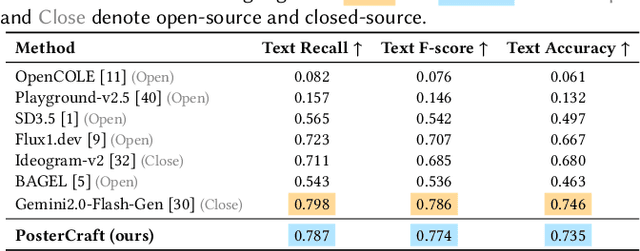
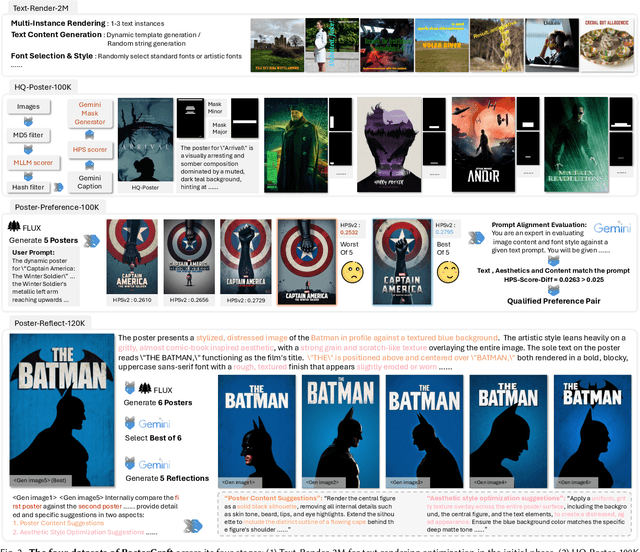

Generating aesthetic posters is more challenging than simple design images: it requires not only precise text rendering but also the seamless integration of abstract artistic content, striking layouts, and overall stylistic harmony. To address this, we propose PosterCraft, a unified framework that abandons prior modular pipelines and rigid, predefined layouts, allowing the model to freely explore coherent, visually compelling compositions. PosterCraft employs a carefully designed, cascaded workflow to optimize the generation of high-aesthetic posters: (i) large-scale text-rendering optimization on our newly introduced Text-Render-2M dataset; (ii) region-aware supervised fine-tuning on HQ-Poster100K; (iii) aesthetic-text-reinforcement learning via best-of-n preference optimization; and (iv) joint vision-language feedback refinement. Each stage is supported by a fully automated data-construction pipeline tailored to its specific needs, enabling robust training without complex architectural modifications. Evaluated on multiple experiments, PosterCraft significantly outperforms open-source baselines in rendering accuracy, layout coherence, and overall visual appeal-approaching the quality of SOTA commercial systems. Our code, models, and datasets can be found in the Project page: https://ephemeral182.github.io/PosterCraft
MagicDistillation: Weak-to-Strong Video Distillation for Large-Scale Portrait Few-Step Synthesis
Mar 17, 2025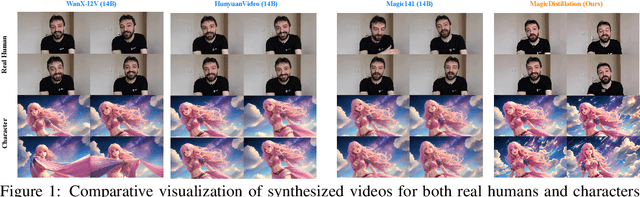
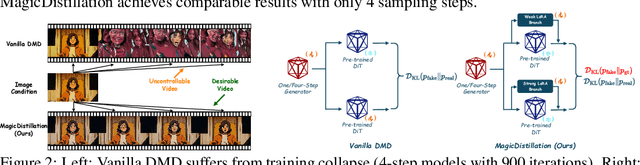
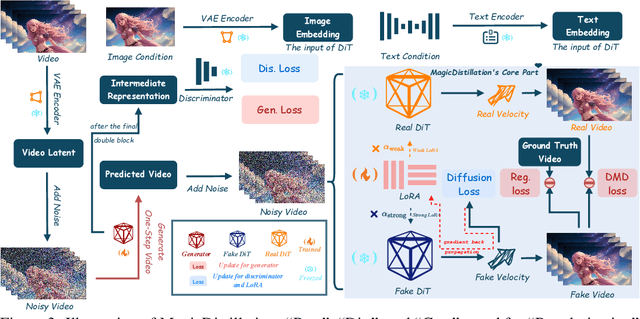
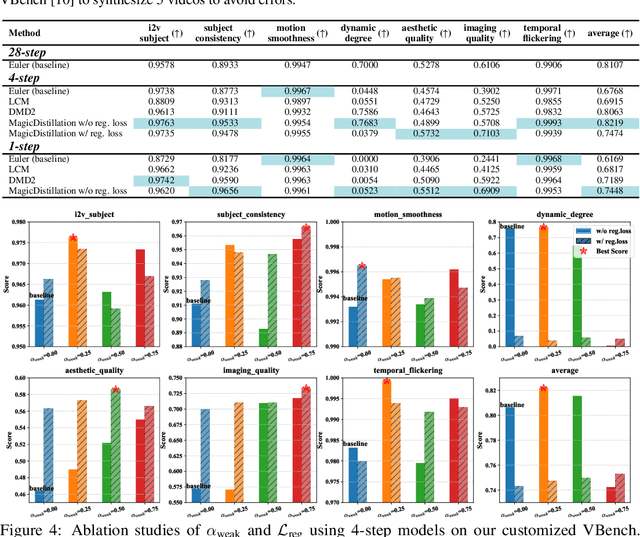
Fine-tuning open-source large-scale VDMs for the portrait video synthesis task can result in significant improvements across multiple dimensions, such as visual quality and natural facial motion dynamics. Despite their advancements, how to achieve step distillation and reduce the substantial computational overhead of large-scale VDMs remains unexplored. To fill this gap, this paper proposes Weak-to-Strong Video Distillation (W2SVD) to mitigate both the issue of insufficient training memory and the problem of training collapse observed in vanilla DMD during the training process. Specifically, we first leverage LoRA to fine-tune the fake diffusion transformer (DiT) to address the out-of-memory issue. Then, we employ the W2S distribution matching to adjust the real DiT's parameter, subtly shifting it toward the fake DiT's parameter. This adjustment is achieved by utilizing the weak weight of the low-rank branch, effectively alleviate the conundrum where the video synthesized by the few-step generator deviates from the real data distribution, leading to inaccuracies in the KL divergence approximation. Additionally, we minimize the distance between the fake data distribution and the ground truth distribution to further enhance the visual quality of the synthesized videos. As experimentally demonstrated on HunyuanVideo, W2SVD surpasses the standard Euler, LCM, DMD and even the 28-step standard sampling in FID/FVD and VBench in 1/4-step video synthesis. The project page is in https://w2svd.github.io/W2SVD/.
CoRe^2: Collect, Reflect and Refine to Generate Better and Faster
Mar 12, 2025Making text-to-image (T2I) generative model sample both fast and well represents a promising research direction. Previous studies have typically focused on either enhancing the visual quality of synthesized images at the expense of sampling efficiency or dramatically accelerating sampling without improving the base model's generative capacity. Moreover, nearly all inference methods have not been able to ensure stable performance simultaneously on both diffusion models (DMs) and visual autoregressive models (ARMs). In this paper, we introduce a novel plug-and-play inference paradigm, CoRe^2, which comprises three subprocesses: Collect, Reflect, and Refine. CoRe^2 first collects classifier-free guidance (CFG) trajectories, and then use collected data to train a weak model that reflects the easy-to-learn contents while reducing number of function evaluations during inference by half. Subsequently, CoRe^2 employs weak-to-strong guidance to refine the conditional output, thereby improving the model's capacity to generate high-frequency and realistic content, which is difficult for the base model to capture. To the best of our knowledge, CoRe^2 is the first to demonstrate both efficiency and effectiveness across a wide range of DMs, including SDXL, SD3.5, and FLUX, as well as ARMs like LlamaGen. It has exhibited significant performance improvements on HPD v2, Pick-of-Pic, Drawbench, GenEval, and T2I-Compbench. Furthermore, CoRe^2 can be seamlessly integrated with the state-of-the-art Z-Sampling, outperforming it by 0.3 and 0.16 on PickScore and AES, while achieving 5.64s time saving using SD3.5.Code is released at https://github.com/xie-lab-ml/CoRe/tree/main.